
What Is 164.68.1111.161 and Why It Looks Like an IP Address
At first glance, 164.68.1111.161 appears to be a standard IPv4 address, which is the format most commonly used on the internet. IPv4 addresses consist of four numerical segments separated by dots, and each segment plays a role in identifying a device or network. Because of this familiar structure, many users assume that any similar-looking number must be a real and functional IP address.
However, not everything that looks like an IP address is valid. In this case, the third segment of 164.68.1111.161 is 1111, which immediately raises a red flag. In IPv4 formatting rules, each segment must fall between 0 and 255. Since 1111 exceeds this range, the address is technically invalid and cannot exist in a real network environment.
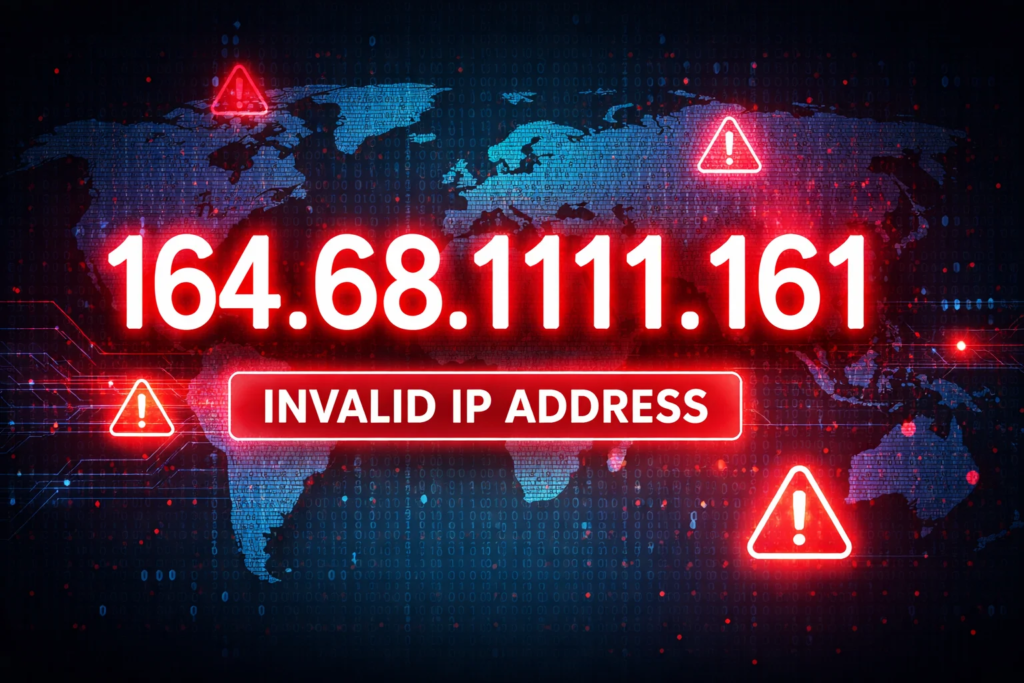
Understanding IPv4 Rules and Why This Address Is Invalid
To understand why 164.68.1111.161 is not valid, it helps to know how IPv4 addressing works. Each IP address is divided into four parts known as octets, and each octet must stay within a strict numerical range. This limitation ensures compatibility across all devices and networks on the internet.
When an address breaks this rule, it becomes unusable. In this case, the value 1111 violates the allowed range, making the entire address non-routable. This means it cannot be assigned to any device, server, or website, and it cannot be used for communication across networks.
Common Reasons You Might See 164.68.1111.161 Online
Even though 164.68.1111.161 is invalid, it can still appear in various places online. One of the most common reasons is simple human error. A person may have intended to type a valid IP address such as 164.68.111.161 but accidentally added an extra digit.
Another possibility is software-related issues. Some scripts, bots, or logging systems may generate incorrect outputs due to bugs or misconfigurations. In such cases, malformed IP addresses like this can appear in logs, analytics tools, or debugging reports without representing real network activity.
Could 164.68.1111.161 Be Linked to Security Threats?
The string itself is not dangerous because it is not a real IP address. However, its presence in certain contexts can still indicate potential issues. For example, if this address appears repeatedly in server logs, it might suggest automated bot activity or scanning attempts.
Some malicious tools intentionally use invalid or fake IP addresses to confuse tracking systems or hide their true origin. This does not mean that every instance is harmful, but it highlights the importance of analyzing patterns rather than reacting to a single occurrence.
Differences Between Valid and Invalid IP Addresses
A valid IP address must follow strict formatting rules that allow it to function within the global internet system. These addresses can be traced, analyzed, and used for communication between devices. They also provide useful data such as approximate location and network ownership.
Invalid IP addresses, on the other hand, do not function in real-world networks. They cannot be traced accurately and often appear as errors, placeholders, or intentionally misleading entries. Understanding this difference helps users avoid confusion when analyzing logs or investigating suspicious activity.
What to Do If You Find 164.68.1111.161 in Logs
If you encounter 164.68.1111.161 in your server logs or analytics data, the first step is to examine the context. Look at the timestamp, request type, and frequency of occurrences to determine whether it is part of a larger pattern.
In many cases, it will simply be a malformed request or a logging issue. However, if it appears alongside unusual activity such as repeated access attempts or abnormal traffic spikes, it may be worth investigating further. Monitoring behavior is always more effective than reacting immediately.
Possible Real IP Variations You Should Check
When dealing with an invalid IP address, it is often helpful to consider whether it might be a mistake. In this case, 164.68.1111.161 could be a typo for a valid address like 164.68.111.161 or a similar variation.
Valid addresses can be investigated using standard tools such as WHOIS lookup and IP geolocation services. For example, a correctly formatted IP like 164.68.111.161 is recognized as a public IPv4 address, although it may not always have active services or known ownership details.
Role of Invalid IP Addresses in SEO and Analytics
Invalid IP addresses can affect how website data is interpreted. In analytics platforms, malformed entries may distort traffic reports, making it harder to distinguish between real users and automated activity.
164.68.1111.161? Learn why this IP address is invalid, how it appears in logs, possible risks, and how to handle suspicious or malformed IP data safely perspective, this can lead to inaccurate metrics such as bounce rates or session counts. Website owners should ensure that their analytics tools filter out invalid or suspicious data to maintain accurate performance tracking and decision-making.
Best Practices for Handling Suspicious or Incorrect IP Data
Handling unusual 164.68.1111.161 IP entries requires a balanced approach. Instead of blocking everything immediately, it is better to analyze patterns and confirm whether the activity is harmful or simply an error.
Modern security systems, including firewalls and intrusion detection tools, can automatically identify malformed IP addresses and treat them as low-priority anomalies. Keeping software updated and ensuring proper log parsing can significantly reduce confusion caused by invalid data.
Final Verdict on 164.68.1111.161 and Online Safety
164.68.1111.161 is not a valid IP address and cannot exist in real-world networking. Its appearance is usually the result of a typo, a software error, or intentionally generated noise. While the address itself is harmless, the context in which it appears can provide useful insights into system behavior