
Introduction
The string 111.90.150.1888 often catches attention because it looks like a typical IPv4 address used in networking and internet communication. Many users assume it represents a real server, device, or online location. However, despite its familiar format, it is not a valid IP address and cannot function within real-world networking systems. This confusion makes it a frequently searched keyword among developers, cybersecurity learners, and users who encounter it in logs or analytics tools.
Understanding why 111.90.150.1888 is invalid requires a deeper look into how IP addresses are structured and how strict validation rules govern internet communication. In most cases, such malformed IP-like strings appear due to system errors, data corruption, or improper input handling. This article explores the technical meaning, real-world context, and cybersecurity implications of this unusual numeric sequence in a clear and user-friendly way.
Understanding the Structure of 111.90.150.1888
The format of 111.90.150.1888 resembles an IPv4 address, which consists of four numeric segments separated by dots. These segments are designed to identify devices and enable communication across networks. However, simply following the dotted format does not guarantee that an address is valid or usable.
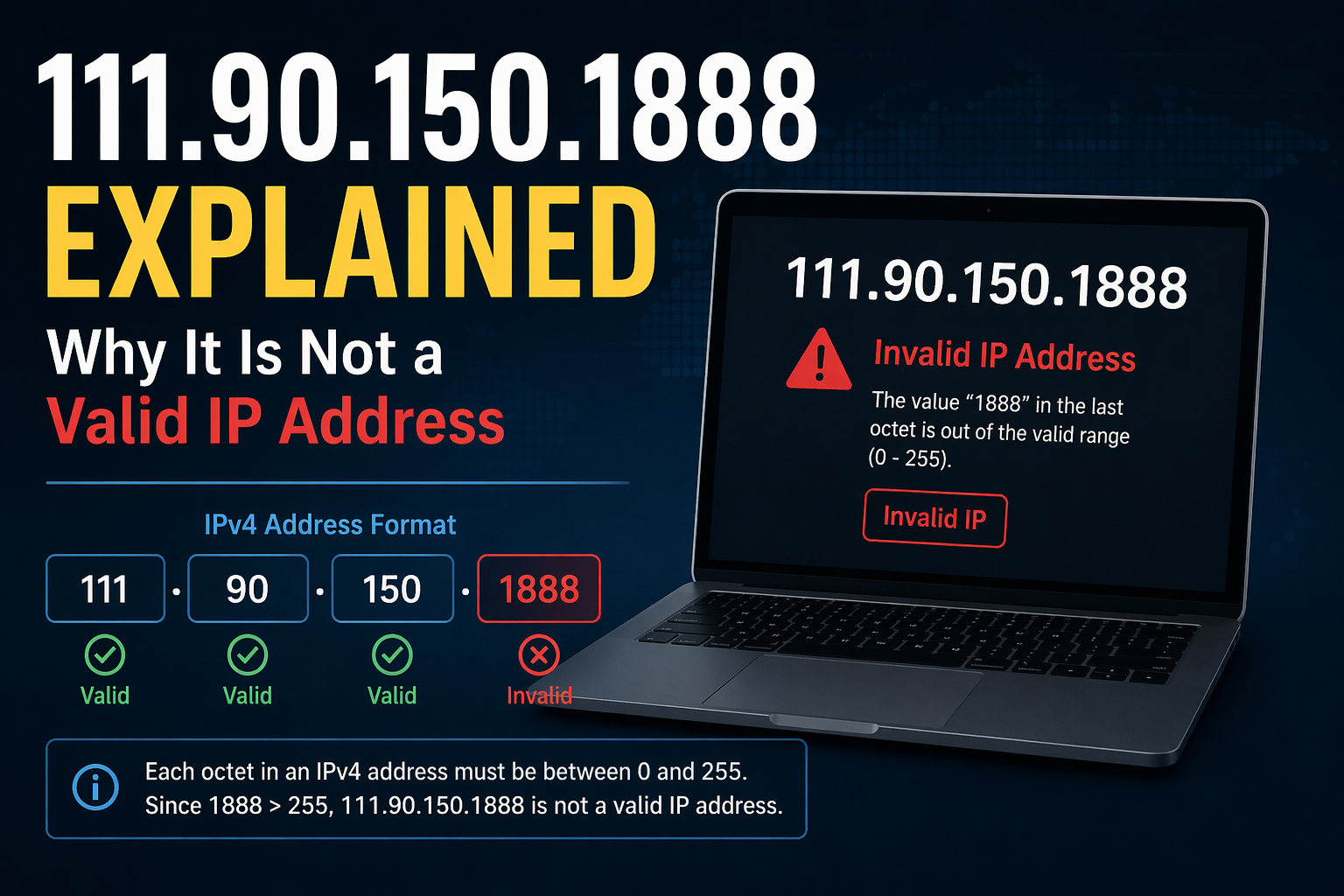
In this case, the first three segments—111, 90, and 150—are within acceptable numeric ranges. This makes the string appear legitimate at first glance. However, the final segment “1888” breaks the structure completely because it exceeds the allowed limit for IPv4 addresses.
This combination of valid-looking and invalid components is what causes confusion. Many users mistakenly believe the address might be partially functional, but in reality, the entire structure becomes invalid as soon as one segment fails the rules.
IPv4 Addressing Rules and Their Importance
IPv4 addresses are built on a 32-bit system divided into four octets. Each octet represents 8 bits of data and must stay within the range of 0 to 255. This rule is fundamental to how computers and networking devices interpret IP addresses.
Because each octet is limited to 8 bits, any value above 255 cannot be converted into a valid binary format. This is why strict enforcement of these limits is necessary. Without these rules, routers and servers would not be able to process or route data correctly across the internet.
In the case of 111.90.150.1888, the final segment violates this rule, making the entire address unusable. This ensures that malformed addresses do not disrupt network operations or cause communication errors.
Why 111.90.150.1888 Is Not a Valid IP Address
The primary reason 111.90.150.1888 is invalid lies in its last segment. The value “1888” exceeds the maximum allowed number for any IPv4 segment, which is 255. As a result, the address cannot be interpreted or processed by any networking system.
Invalid IP addresses like this are automatically rejected by routers, DNS systems, and servers. They cannot be assigned to devices, cannot host websites, and cannot be used to send or receive data.
This strict validation is essential for maintaining the stability of the internet. It ensures that only properly formatted addresses are used in communication, preventing errors and misrouting of data packets.
Real Context of the 111.90.150.x IP Range
While 111.90.150.1888 is invalid, the base range 111.90.150.x is part of a legitimate IPv4 allocation. Many valid IP addresses within this range are actively used in real-world networks, particularly in hosting environments.
Data from IP intelligence sources shows that addresses in this range are associated with infrastructure in regions like Malaysia. These IPs are often used for hosting websites, managing servers, and supporting cloud-based services.
This means that although the base structure is real, extending it beyond valid limits—as seen in 1888—makes the entire address non-functional.
Common Reasons Behind Invalid IP Formats
Malformed IP addresses like 111.90.150.1888 usually appear due to technical or human errors. One of the most common causes is incorrect data entry, where extra digits are accidentally added to a valid IP.
Another reason is software bugs or misconfigured applications that fail to validate input properly. When systems process data without strict validation, invalid IP-like strings can be recorded in logs or analytics reports.
Additionally, automated bots or scripts may generate random numeric patterns that resemble IP addresses. These are often meaningless and do not correspond to real devices, yet they still appear in monitoring systems.
Appearance of 111.90.150.1888 in Logs and Search Queries
Users often encounter strings like 111.90.150.1888 in server logs, error reports, or search engine results. These entries usually do not represent real network traffic but are instead artifacts of system behavior.
For example, logging systems may capture malformed input when parsing requests incorrectly. Similarly, corrupted data during transmission between systems can produce invalid IP entries.
Search engines may also index these values when they appear on websites or in publicly accessible logs, leading to increased curiosity and search activity around such keywords.
Cybersecurity Perspective on Invalid IP Addresses
From a cybersecurity standpoint, invalid IP addresses like 111.90.150.1888 are generally not direct threats. Since they do not correspond to real network endpoints, they cannot be used for actual communication or attacks.
However, their presence in logs can still provide useful insights. Repeated occurrences may indicate automated scanning activity, bot traffic, or misconfigured systems generating noise.
Security tools typically filter out invalid IP addresses during analysis to focus on legitimate threats. This helps reduce false positives and improves the efficiency of threat detection systems.
Importance of IP Validation in Modern Networking
IP validation is a critical component of modern networking systems. It ensures that only correctly formatted addresses are processed, preventing errors and maintaining system reliability.
When invalid addresses like 111.90.150.1888 are detected, they are immediately rejected. This prevents them from entering routing systems or causing disruptions in communication.
Proper validation also helps protect networks from malicious input and ensures that data flows smoothly between devices across the internet.
Misconceptions About IP Address Legitimacy
A common misconception 111.90.150.1888 is that any numeric string formatted like an IP address must be real. In reality, formatting alone is not enough; each segment must follow strict numeric rules.
Another misunderstanding is that invalid IPs may still be traceable or linked to hidden systems. This is not possible because networking systems do not recognize malformed addresses.
Some users also assume that unusual IP patterns automatically indicate cyber threats. While this can sometimes be true, most invalid IP entries are simply the result of technical errors or system-generated noise.
Conclusion
The string 111.90.150.1888 is not a valid IP address and cannot function in any real networking environment. Although it resembles a legitimate IPv4 format, the final segment exceeds the allowed range, making the entire address unusable.
Its appearance in logs, search queries, or technical discussions is usually the result of input errors, software issues, or automated data generation. It does not represent a real device, server, or network location.
Understanding why 111.90.150.1888 is invalid helps clarify how IP addressing systems work and why strict validation rules are essential for maintaining internet stability. It also highlights the importance of accurate data handling in modern digital infrastructure, where even small formatting errors can lead to confusion if not properly understood.