
Introduction
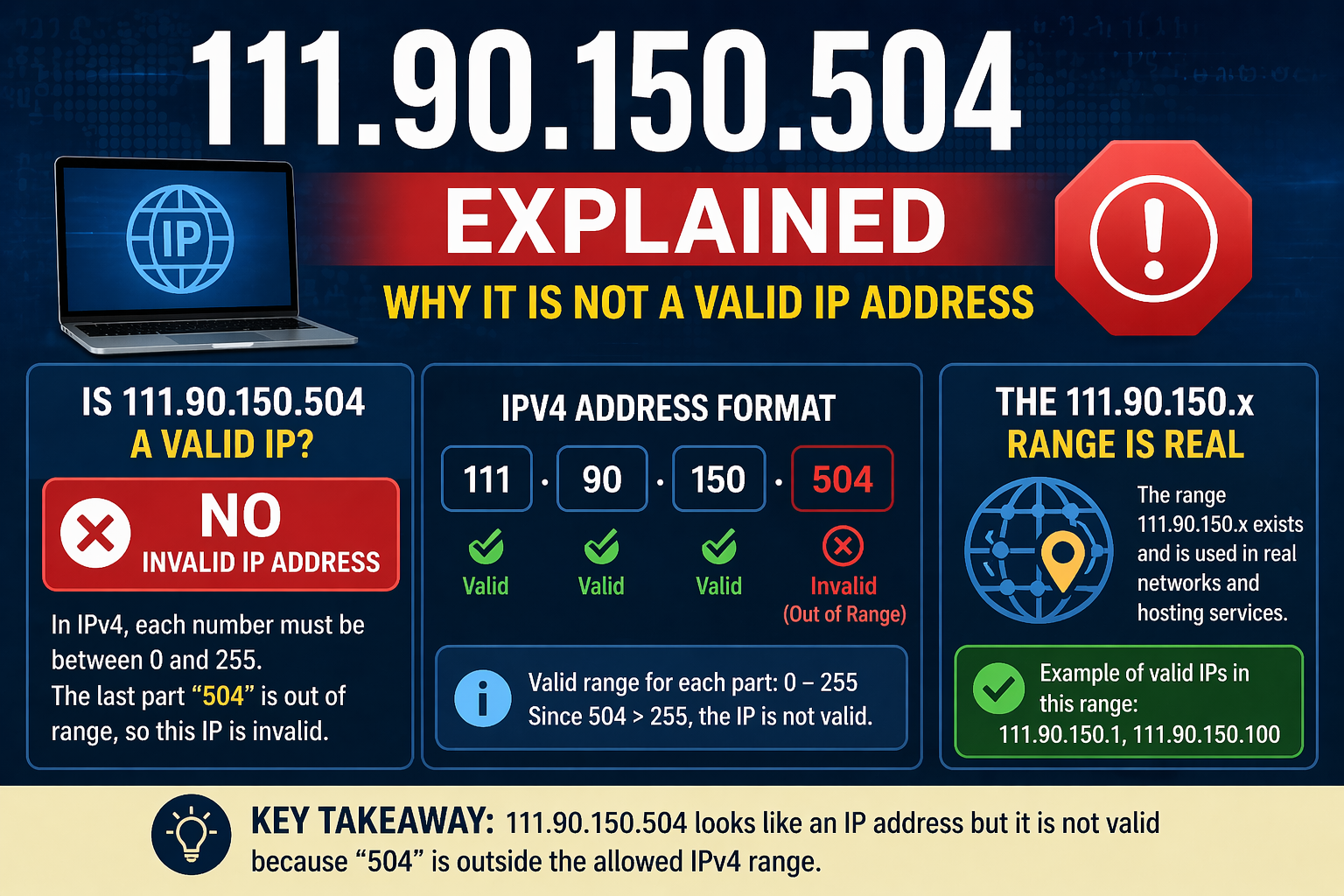
The string 111.90.150.504 often appears in search queries, server logs, or technical discussions, leading many users to believe it represents a real IP address. At first glance, it follows the familiar dotted format of an IPv4 address, which is commonly used to identify devices connected to the internet. However, despite its appearance, this specific sequence is not valid in any real networking environment.
Understanding why 111.90.150.504 is invalid requires a solid grasp of how IP addresses function and why strict formatting rules exist. IP addresses are the backbone of internet communication, allowing data to travel between devices accurately. When these rules are violated—even slightly—the address becomes unusable. This article explores the structure, meaning, causes, and implications of this invalid IP-like string while providing clear, trustworthy insights based on real networking principles.
What 111.90.150.504 Means in Technical Context
The sequence 111.90.150.504 is structured like an IPv4 address, which consists of four numerical segments separated by dots. These segments are designed to uniquely identify devices and enable communication across networks. However, simply following the visual pattern does not guarantee that an IP address is valid.
In this case, the first three segments—111, 90, and 150—are within the acceptable range used in IPv4 addressing. This makes the string appear legitimate at first glance. However, the last segment “504” breaks the structure entirely because it exceeds the allowed numeric limit.
This combination of partially valid and invalid components is a common reason why such strings create confusion among users. While it resembles a real IP address, it cannot function in any networking system.
IPv4 Address Rules and Why They Matter
IPv4 addresses are based on a 32-bit system divided into four octets. Each octet represents 8 bits of binary data and must fall within the range of 0 to 255. This limitation is fundamental to how computers interpret and route IP addresses.
If any segment exceeds this range, the address cannot be converted into binary form, which makes it unusable. For example, an address like 256.100.50.25 is invalid because one segment exceeds 255.
These strict rules ensure that internet communication remains stable and consistent. Without them, routers and servers would struggle to process addresses correctly, leading to network errors and data delivery failures.
Why 111.90.150.504 Is Not a Valid IP Address
The key issue with 111.90.150.504 lies in its final segment. The number “504” exceeds the maximum allowed value for any IPv4 octet, which is 255. Because of this, the entire address fails validation and cannot be used for communication.
Networking systems automatically reject such invalid addresses. They cannot be assigned to devices, used for hosting, or processed by routers and DNS systems. This ensures that malformed data does not disrupt network operations.
Similar invalid IP patterns often appear due to formatting mistakes, and they are consistently treated as non-functional by all standard internet protocols.
Real IP Range Behind 111.90.150.x
Although 111.90.150.504 is invalid, the base range 111.90.150.x is part of a real IPv4 allocation used in global networking. Valid addresses within this range can be assigned to servers, websites, or user devices by internet service providers.
IP addresses serve as unique identifiers that allow devices to communicate across networks. They are assigned either dynamically or statically depending on the network setup.
This means that while addresses like 111.90.150.100 may exist and function normally, extending the final segment beyond the valid range—as in 504—makes the entire address unusable.
Common Causes of Invalid IP Addresses
Invalid IP addresses like 111.90.150.504 usually appear due to human or system errors. One of the most common causes is incorrect data entry, where extra digits are accidentally added.
Another frequent cause is software misconfiguration. Applications that fail to validate input properly may store malformed IP addresses in logs or analytics systems. Data corruption during transmission can also lead to similar issues.
Automated bots and scripts may generate random numeric patterns that resemble IP addresses but do not follow proper formatting rules. These entries often appear as noise in monitoring systems rather than real network activity.
Why You See 111.90.150.504 in Logs and Analytics
Many users encounter strings like 111.90.150.504 in server logs, firewall reports, or analytics dashboards. These entries typically do not represent real traffic but are artifacts of system behavior.
Logging systems are designed to capture all incoming data, including malformed input. If a system does not filter invalid entries, they may appear alongside legitimate IP addresses. This can create confusion for users reviewing logs.
Search engines may also index such values when they appear on websites or forums, which increases their visibility and leads to more user searches.
Cybersecurity Perspective on Invalid IP Formats
From a cybersecurity standpoint, invalid IP addresses are generally not direct threats. Since they do not correspond to real devices, they cannot be used for communication or attacks.
However, their presence can still provide useful insights. Repeated occurrences may indicate automated bot activity, misconfigured systems, or attempts to inject malformed data into logs.
Security systems typically filter out invalid IPs to focus on legitimate threats. This helps reduce false positives and ensures that analysts can concentrate on meaningful network activity.
Importance of IP Validation in Networking Systems
IP 111.90.150.504 validation plays a critical role in maintaining stable and secure network operations. Every incoming IP address is checked against strict rules before it is accepted by a system.
If an address fails validation, it is rejected immediately. This prevents routing errors, data corruption, and potential security vulnerabilities.
By enforcing these rules, networking systems ensure that only correctly formatted addresses are used, which keeps communication efficient and reliable across the internet.
Conclusion
The string 111.90.150.504 is not a valid IPv4 address, even though it appears similar to one. The final segment exceeds the allowed range, making the entire address unusable in real-world networking systems.
Its presence in logs, analytics tools, or search queries is usually the result of input errors, software issues, or automated data generation. It does not represent a real device or network location.
Understanding why this address is invalid highlights the importance of strict IP formatting rules and proper validation systems. These rules ensure that the internet remains stable, secure, and capable of supporting billions of connected devices without confusion or errors.